Getting Around The Train
Detailed info on getting around the Coach car, Observation/Cafe car, and accessibility on the train.

This is one of the big unknowns until you get on the train, which can be a big stressor for some people, so I'll do my best to explain the layouts of the cars! You can also get a general idea of the layouts of the Superliner cars on this website, which has the images I've included in this entry. That said, our layouts were a little bit different in one direction we traveled, but it will give you a general idea.
This post only has details on the Coach and Cafe/Observation cars. These posts are mostly from my experience on our trip, with links to the applicable Amtrak pages for more info. Since we rode in Coach, I didn't have access to the Sleeper cars, and we didn't eat in the Diner (more on that in the food post).
I've also included details on bathrooms, the stairs, the seats, and accessibility in general on the train below. Unfortunately, I didn't take a picture of these areas, but I linked to additional info when I could find it.
Coach Cars
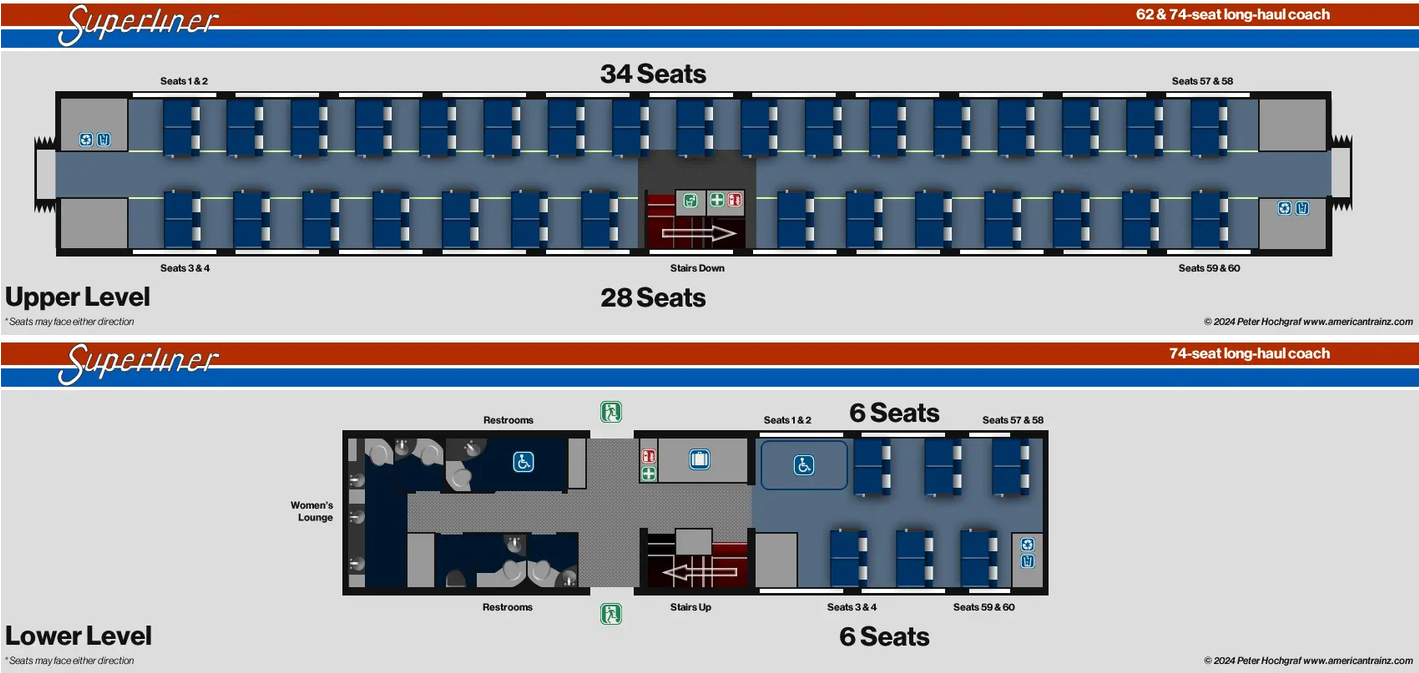
Layout: Superliner coach cars have two levels, shown on the image above. You enter on the bottom level in the middle of the car (the lower part of the image). Once you are on, you will see bathrooms (more details on those in a minute) to one side and lower-level seating to the other side.
There is an area to put carry-on luggage that doesn't fit up the narrow stairs across from the staircase. Directly opposite the luggage area, you'll see the staircase to get up to the second level. If your car has a water spigot, you'll find it here, next to the stairs. The stairs are U-shaped and fairly narrow, and there is a railing. Next to the stairs, there is a door that leads into lower-level seating.
Lower-level seats: Seats on the lower level are reserved primarily for people with accessibility needs, and should be selected when you book your ticket. If you don't have a seat in this area, there's no reason to go in - it doesn't lead to any other area of the train. In addition to physical limitations, lower-level seats would be a great option for people with compromised immune systems (less exposure to people, no people passing by) and people who need areas for reduced sensory input.
Upper level seats: On the second level, you will see rows of seats, 2 seats per side with the aisle down the middle. (The top part of the image above.) On either end of the car, there will be doors to travel to the next car.
Keep in mind, in Superliner cars, there is no way to travel between cars from the lower level without leaving the train, and there are no restrooms on the upper levels. This becomes important if you are disabled or otherwise can't traverse the staircase.
Seating FAQs
- You are not assigned specific seat numbers, but may be directed to a specific car. Make sure you are in the right car, or you might end up at the wrong destination! The Empire Builder splits at Spokane, and some cars go to Portland, and others go to Seattle. If you're not in the right car, you could end up somewhere unexpected!
- Conductors will come through and check your ticket and will leave a piece of paper with your destination on the rail above your seat. This is how they know who is getting off where. They should wake you up if you're at your destination, but there are a lot of passengers and only one of them, so it's a good idea to set an alarm!
- You will be seated next to a stranger if you are traveling alone and they need the space. There were no armrests on the chairs, so keep that in mind when sharing the seat. The chairs are larger than a typical airline chair and are more comfortable. (See the post with info on sleeping for more details on that.)
- Seat details:
- Each row of seats has two plugs, one for each seat, under the window. So, if you're on the outside seat, you'll need to stretch your cord across your seatmate's space - make sure you have long cords!
- Each seat has a table that folds down, similar to a plane, but the table is larger.
- There is space above your head for baggage if needed. You can fit small items under the chair in front of you, but not a stuffed backpack.
- Don't count on wifi - you probably won't have any. Download anything you want to watch or listen to on the trip.
Observation and Cafe Cars
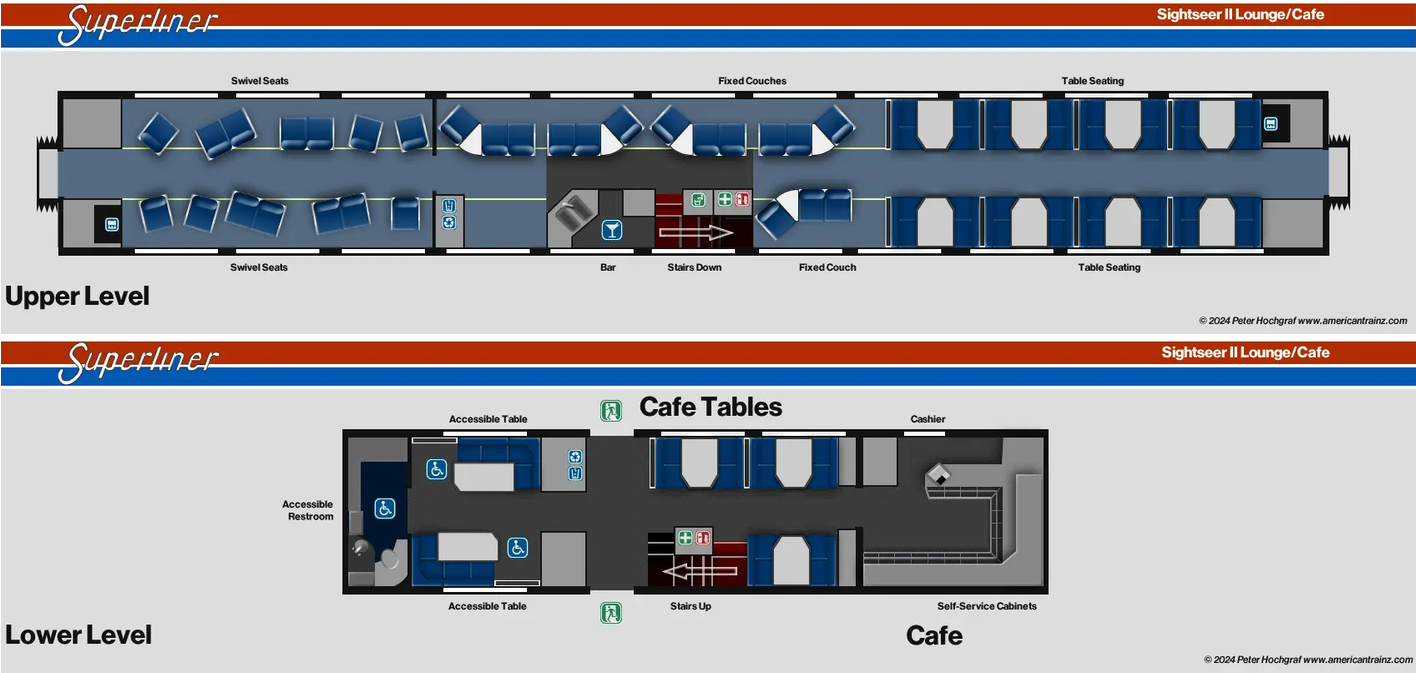
The Observation area and Cafe area are in the same car; the Observation area is on top, and the Cafe area is below it. The Observation area has large windows and a mix of tables with booths and areas with chairs, and is designed for watching scenery, eating, and generally giving you a space to get away from your seat. You will enter the Observation car from the second level of a Coach car.
In the middle of the Observation car, there is a staircase to go down to the Cafe area. You'll see some tables with benches, and then to one side, you'll see the sales area. To the other side, you'll see more tables, and (theoretically) bathrooms - but both times, this area was blocked off from passenger use.
Sometimes, the crew will "reserve" the tables near the cafe area for their own use or use them as a work area, which we saw on one direction of our trip, so don't count on the seating area here being available. Some of the Cafe cars have doors to the outside in the middle of the car, but I only ever saw these opened to take trash in and out. So, the only guaranteed way to access the Cafe car is via the staircase in the Observation car.
On the Empire Builder, the Observation/Cafe car detaches from the train and continues to Portland with the Portland passenger cars. The Diner car continues to Seattle with Seattle passenger cars. So, if you are eating Diner meals but heading to Portland, plan on eating from the Cafe after Spokane (Westbound) or before Spokane (Eastbound). Make sure to check out the post on eating on the train for more details.

Bathrooms
Bathrooms are found in Coach cars and Sleeper cars. Sleeper cars are only for people who have tickets for a Sleeper room, so plan on using the bathrooms in the Coach cars. All bathrooms are, like I mentioned above, on the lower level of the cars. There is one larger accessible bathroom, 2-3 smaller bathrooms, and 1 bathroom that has an additional small seat area. Check the layout image above to get an idea of the configuration.
Most Coach cars also have a "Women's Lounge," which is a small room behind a door with two small stools, a counter, and a sink, as well as an additional small bathroom. The door to the Lounge area doesn't lock, but the bathroom (of course) does. Presumably, this area is for nursing, but it's also a bit of a holdover from gender segregated lounges on trains. Multiple bathrooms have fold-down changing areas for infants, too.
The regular bathrooms are small. Like, small small - I have used some roomier airplane bathrooms. I recommend using the bathroom with the additional seat if you need some room, though keep in mind it is longer, not wider. The accessible bathroom is the best option if you have a larger body. All bathrooms have a grab bar for jostles, which you'll probably need at some point.
Cleanliness: The bathrooms can get a bit gross, and supplies can run low towards the end of the route if the attendants don't keep up with things. Some people online recommended bringing Clorox wipes in case things get gross; ours never got that bad, but I also would tell an attendant if it was ever dirty enough that you felt like you needed bleach wipes. Clean up after yourself. Oh, and make sure your door is locked.
Stairs, Walkways, and Between Trains
The stairs are narrow, relatively steep, and have two 90-degree angle turns. I can't find an exact measurement of the stairwells, but my best guess is no wider than 3 feet. There are handrails and non-slip treads on the stairs.
To get between trains, you'll need to press a button on one door to exit, walk between the cars on a connected walkway, and press the button on the door of the train car you're entering. There are safety bars you can grab to the side of the door if needed. You're required to wear shoes when walking around the train, particularly when traveling between cars - keep your feet safe!
Accessibility On The Train
One thing I liked about traveling by train is how clear accessibility is. Airports often feel very much like playing roulette, and access can vary airport to airport. Planes are also quite cramped, which doesn't bode well for people who need mobility devices. Trains also give you a variety of settings that can serve as accommodations. That said, there are absolutely some limitations that are important to plan for while on the train for multiple days.
Movement on and Around the Train
Getting on and off the train varies by location. Some stops will have a stool placed on the ground outside, and others have a raised platform so it is a regular step down. There is a ramp that an attendant can attach to the train entrance/exit for wheeled mobility devices. The walkways on and off the train and into the lower level seating are all ADA-compliant and wide enough for a wheelchair or other mobility device. (More info on wheeled mobility device service and access here.)
The second level is not accessible with any wheeled mobility device; you could possibly get by with a cane once you get up the stairs, but you would need to go up and down the stairs each time you needed to use the bathroom (in Coach cars). If there's any question that you may not be able to navigate the stairs, I recommend booking a lower-level seat.
If you need to sit in the lower level of the train and can't use the stairs, you will need a plan for your meals: either set up meal service to have food brought to you, carry on your own food, or have someone with you who can get to the Cafe car to get food. (More on meals in the Eating & Sleeping post.)
Managing Sensory Needs On the Train
Managing sensory needs on the train may be a challenge, depending on the sense. Smells, sound, light, and texture are all things to consider and plan for, as well as temperature regulation and vestibular sensitivity.
- Smells: Wearing a mask can help reduce smells, as well as strategically choosing your seat. If you decide to use something scented to counter the smells around you, be respectful of other people's smell sensitivities too!
- Sound: I can't recommend noise-cancelling devices enough. The train is loud; your neighbors will be loud. Loops or other sound-dampening earplugs could help during the day.
- Light: Bring eye masks, sunglasses, and whatever else you normally use to manage light exposure in your day-to-day life. Some hoodies have flip-down eye masks (Comfrt has an affordable one!)
- Temperature: Dress in layers and bring options. Have a blanket, if needed. You can ask the attendant to change the temperature if you're really struggling, but the majority will rule, and you may not get to keep your temperature.
- Vestibular: The motion of the train can be a bit disorienting. Consider bringing medicine for motion sickness, if you can take it (check with your doctor). Keep your eyes on the horizon. Avoid looking at screens if that makes things worse for you. Try using acupressure or a motion sickness band on the point Pericardium 6 (about 3 fingers' width below your wrist in the center of the inside of your arm).
- Texture: The seats may feel weird for you, so consider wearing soft pants (or whatever your preferred texture is) or bring a blanket to cover them.
If reduced sensory input would be helpful for you, consider the lower level seats. Because this area doesn't lead to other parts of the train, you have much less foot traffic. It feels a bit cave-like at night, and there are many fewer fellow passengers, so it can be less sensory info to navigate. Generally, I found the pace of train travel to be much more relaxing for my sensory needs, but your experience may vary!
Discounted Tickets When Traveling With a Disability
Amtrak provides a 10% discount to any disabled traveler and their traveling companion (more info on that here). This is easy to do when purchasing your ticket. No proof is required, except for the specific routes listed on their website (Downeaster, Pennsylvanian, and Keystone), because those routes have a 50% discount.
Amtrak has additional info, as well as the improvements they have already made and planned improvements in the future, on their website. From this trip, I will say that it felt like Amtrak was more accommodating than airlines in general.