Eating and Sleeping on An Amtrak Train
Tips and strategies on eating and sleeping in Coach on a long-distance Amtrak trip.
This is an installment in my brain dump about taking the Empire Builder from Minneapolis to Portland and back. Check out the original entry here, with links to additional posts, including info on getting around the train, accessibility, and more. -K
Eating On The Train
There are two ways to buy food on the Empire Builder: the Cafe car and the Diner car. The Cafe car offers grab-and-go type food that they will reheat for you in a microwave, along with bottled or canned drinks, snacks, etc. The prices are not exorbitant, but they aren't cheap, either. The Diner car is more restaurant-style, with a limited menu.
Meals in the diner car are included in Sleeper car tickets; if there is space available, Coach passengers can eat in the diner for an additional fee ($20 for breakfast, $25 for lunch, $45 for dinner - per person, plus tip). Amtrak has sample menus available on their website. Vegan and Kosher meals can be ordered up to 24 hours before departure, but if you have food allergies or dietary requirements, you're out of luck for meals on the train.
Another thing to keep in mind: on the Empire Builder, the Observation/Cafe car travels to Portland and the Diner car travels to Seattle, and they join at Spokane. So, keep your route and timing in mind when planning your meals (and your budget!). If you're Westbound, you'll only have access to the Cafe car between Spokane and Portland (so, at least breakfast) and no Diner car; if you're Eastbound, you won't have access to the Diner until Spokane (so, your first dinner will be from the Cafe car). If you're leaving Seattle, it's the same meals, but instead of the Cafe, you'll only have the Diner - a much more expensive option.
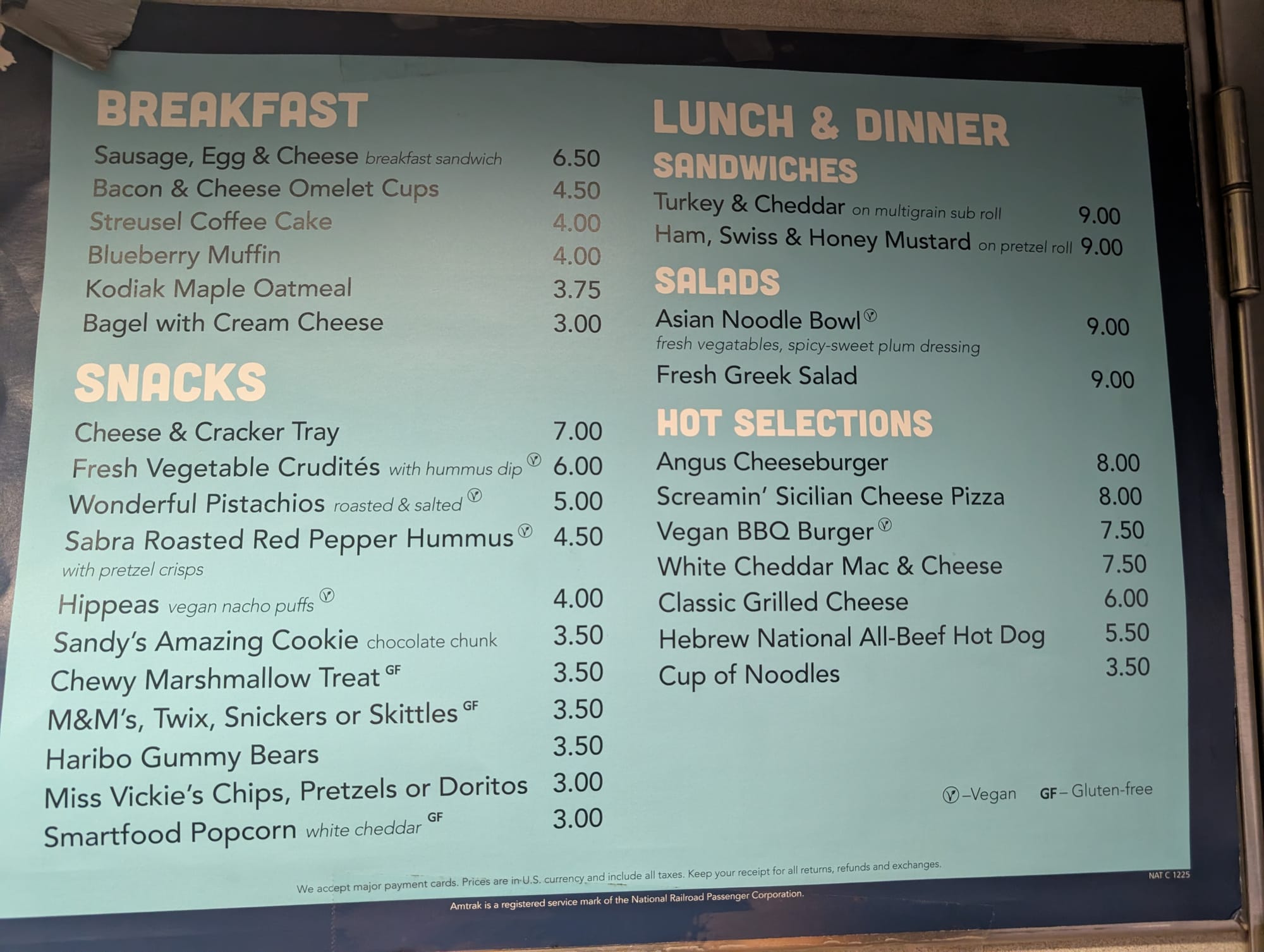
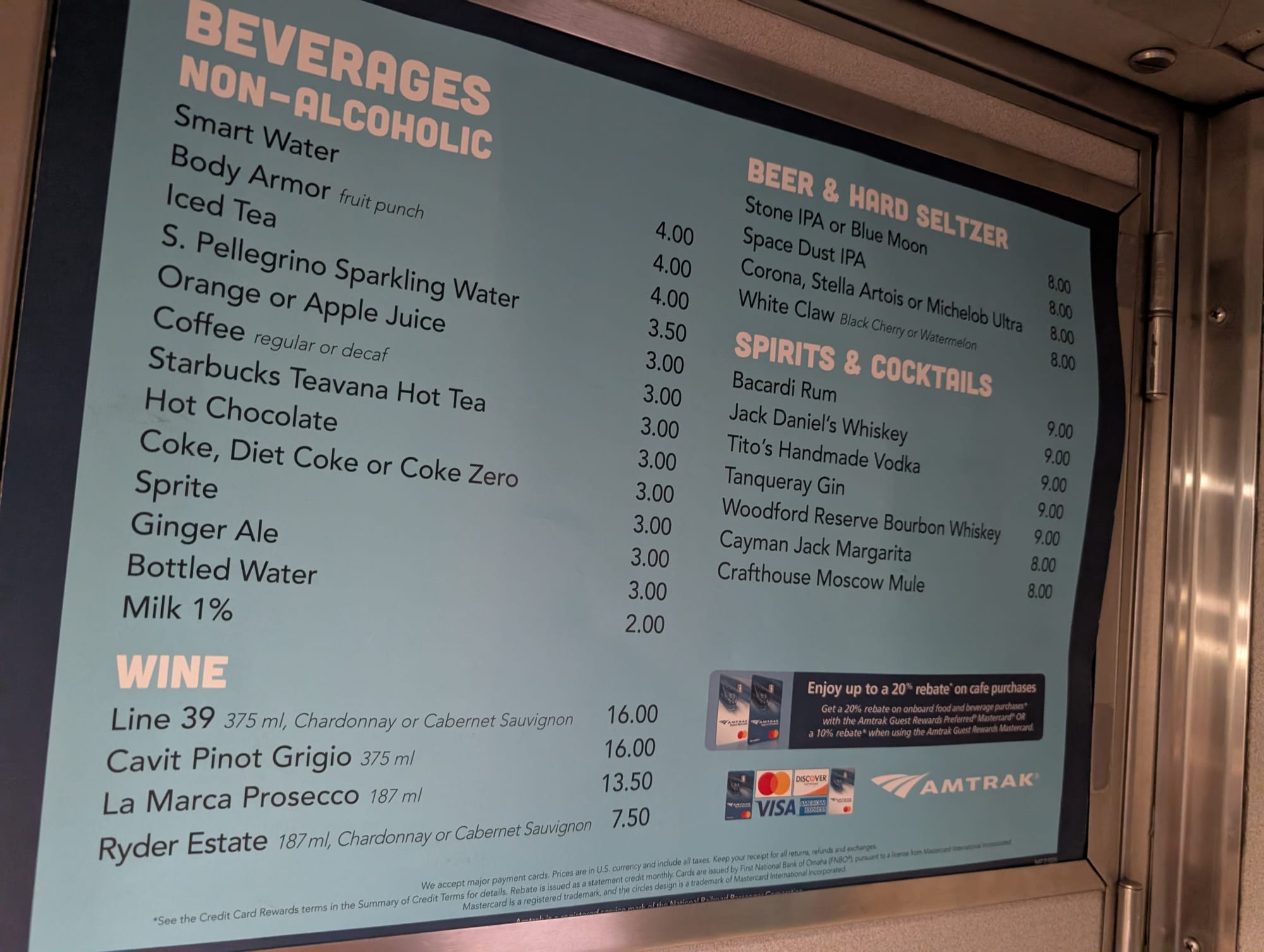
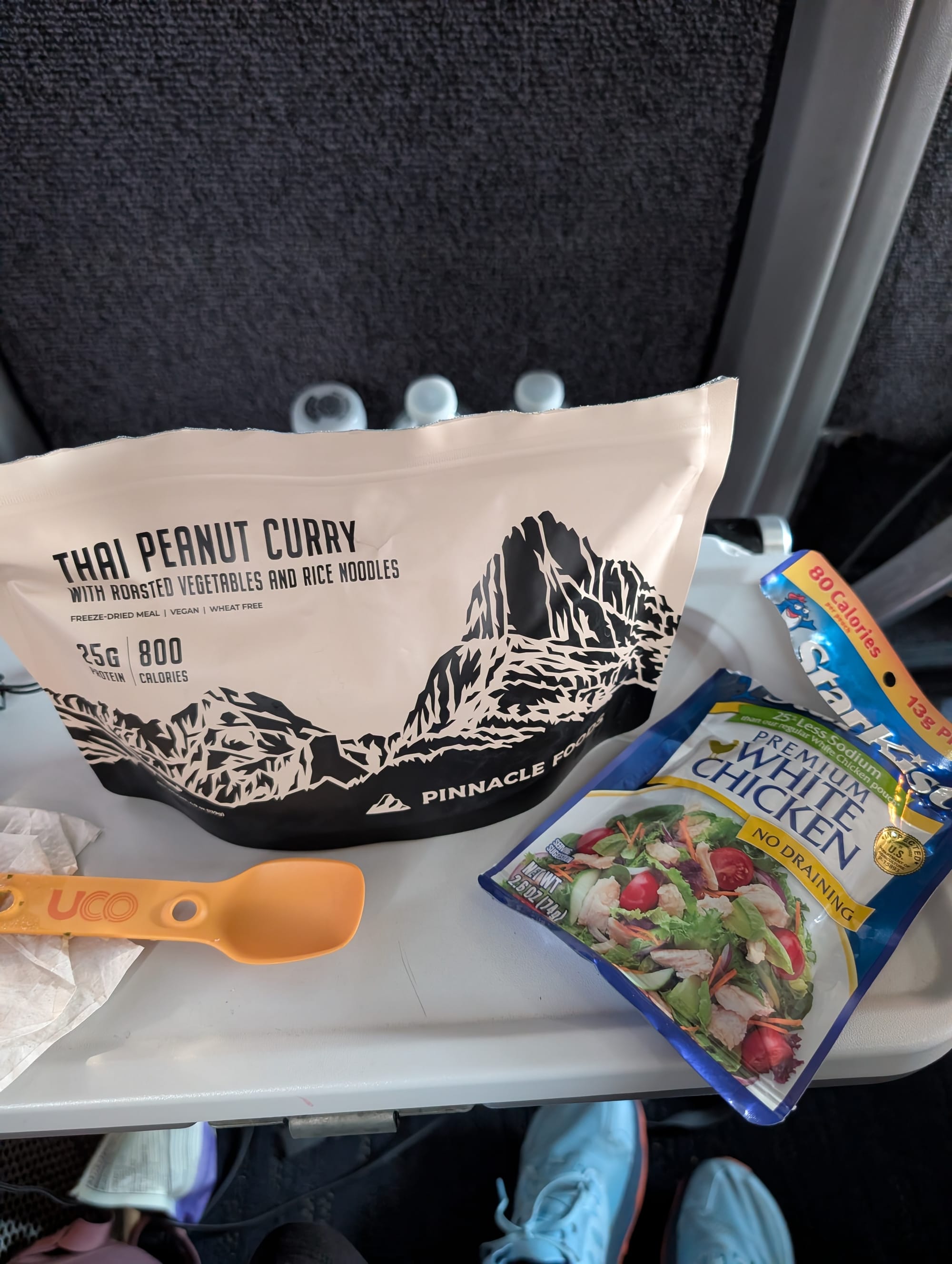
Example cafe car menus from 2026, and an example of our train cuisine 😂
Planning Your Meals
I can't eat gluten or dairy, so I knew I couldn't count on food in either the cafe or diner cars for any of my meals. Planning your meals if you need to carry on everything is a little bit of a puzzle! Here are the details on what is and isn't available on the train, how to figure out which meals you need to plan for, and a few tips on what we did.
Here is what is and isn't available while on the train:
- You are allowed to carry on food and drink (including alcohol, if that's your thing), and you can bring it in a cooler. (More details about bringing food on the train.)
- There is no public microwave.
- Free hot water is available in the cafe car, but it must be given to you in the Amtrak 8 oz cups.
- Room-temperature water is only available in bottles, and runs $3-4 per bottle. They'll give you a cup with ice if you want it chilled.
- Some cars have water spouts for refilling bottles - our Westbound train did, but our Eastbound train didn't. So, budget for buying water or carry enough on.
Here is how I planned our meals:
- Check the meals you need to plan for based on your itinerary, then add 1-2 in case of delays. I laid out which meals we would need to eat on the train, then added 2 in case of delays, which ended up being 2 each for breakfast, lunch, and dinner (and, of course, snacks). The meals have different timing depending on the direction: breakfast was our first meal Westbound from Minneapolis, but dinner was our first meal Eastbound from Portland.
- Decide which meals get fresh food based on how long they will be in the cooler. Our cooler keeps things cold for about 10 hours. So, for example, when traveling Westbound, breakfast the first day was yogurt and granola with some other foods; lunch was sandwiches with lunch meat; dinner was a freeze-dried meal; breakfast the next morning was a room-temperature protein shake and granola, etc. (Making yourself sick from spoiled food would be a bad call on the train!)
- Think outside the box a bit (or imagine you're camping) when picking your food. My biggest win, I think, was thinking of using freeze-dried camping meals for dinner; add the free hot water, and you're all set!
A few tips:
- Our favorite camping meal was Pinnacle Foods' Thai Style Peanut Chicken Curry - it genuinely tastes good and has almost enough calories to split it between two people; we just added a packet of additional chicken. (We got it from Garage Grown Gear.) It also only needs 8 oz of water, which makes getting water from the Cafe car very simple!
- We used a cooler backpack and had another backpack for non-cold food (and other items). You get two included carry-ons per person, so there was still plenty of carry-on space (though, yes, it was a lot to lug around).
- We used frozen water bottles as our ice packs, so we were able to drink those when we needed water, cutting down on the number we needed to buy.
This level of planning will seem like overkill unless you have specific food requirements! You can simplify things if you don't have such specific needs, or just buy food on board.
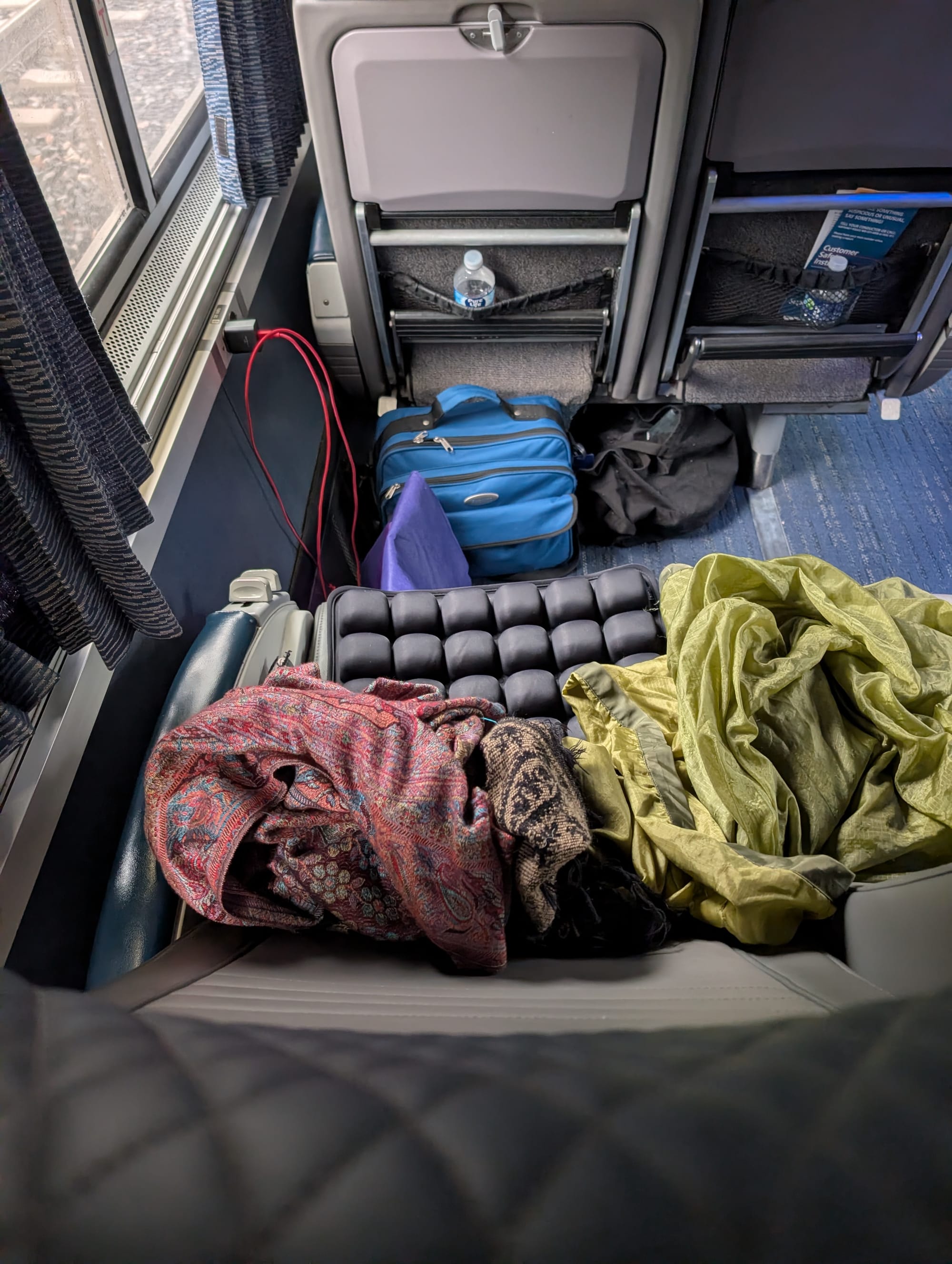
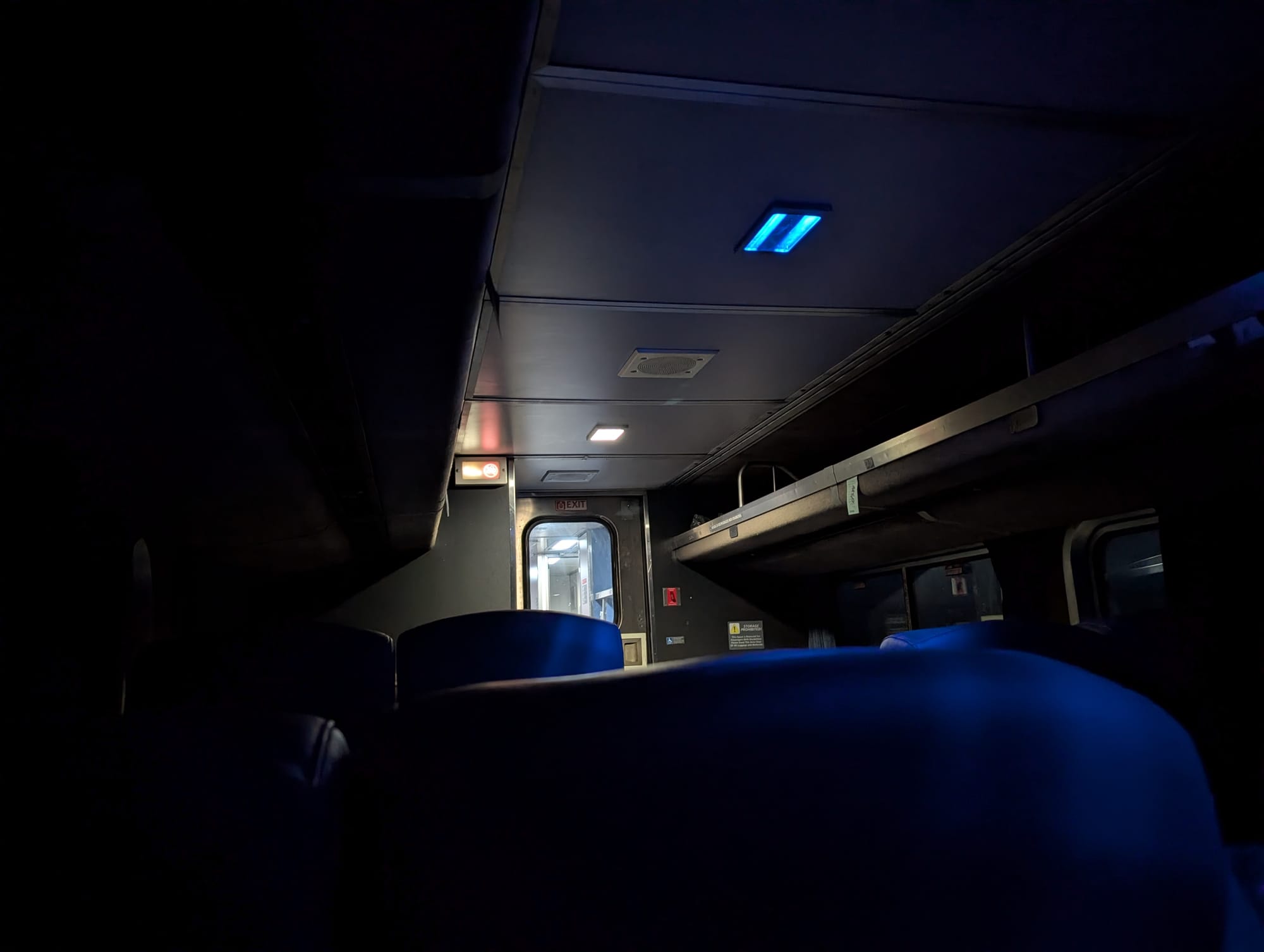
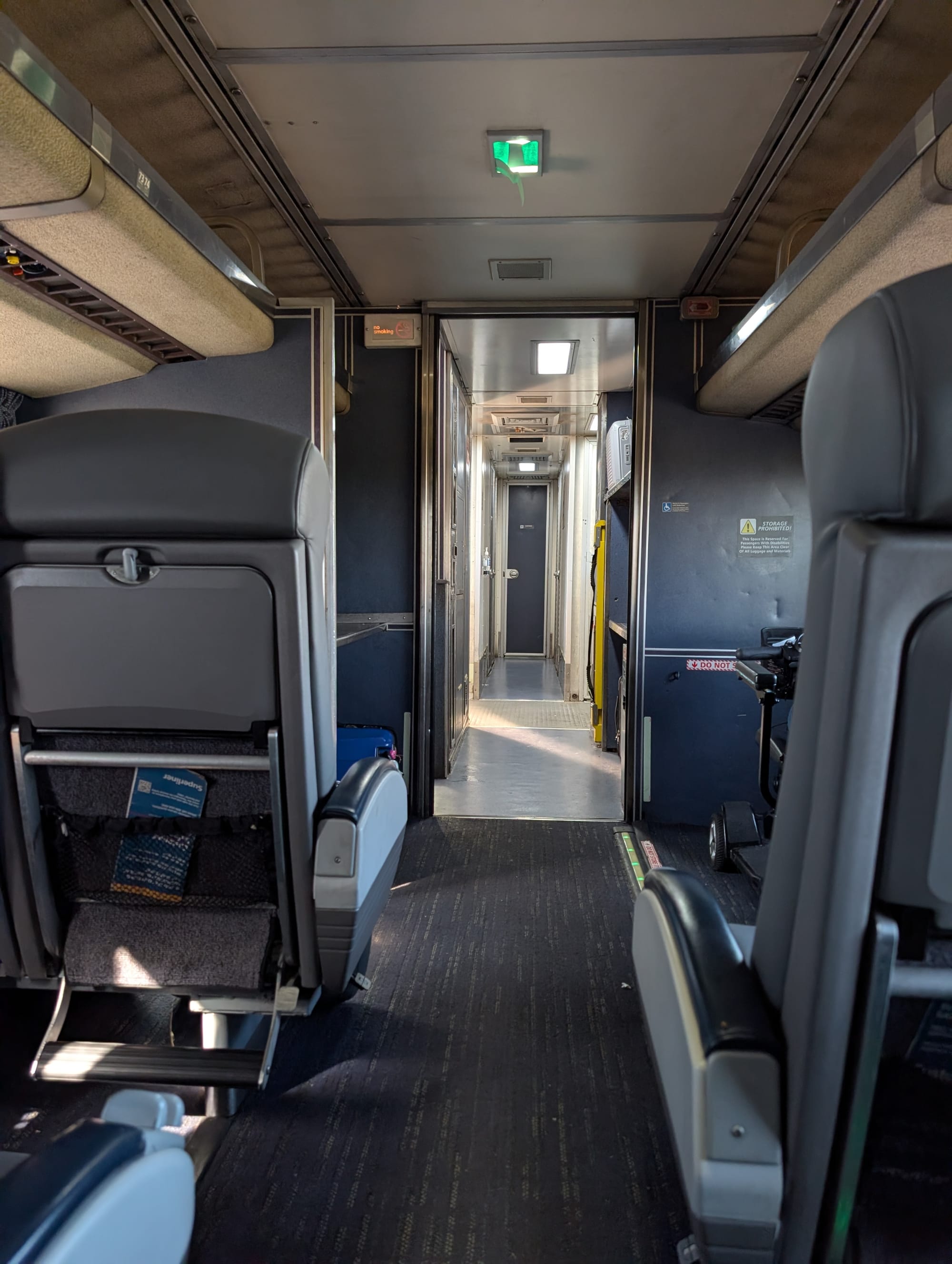
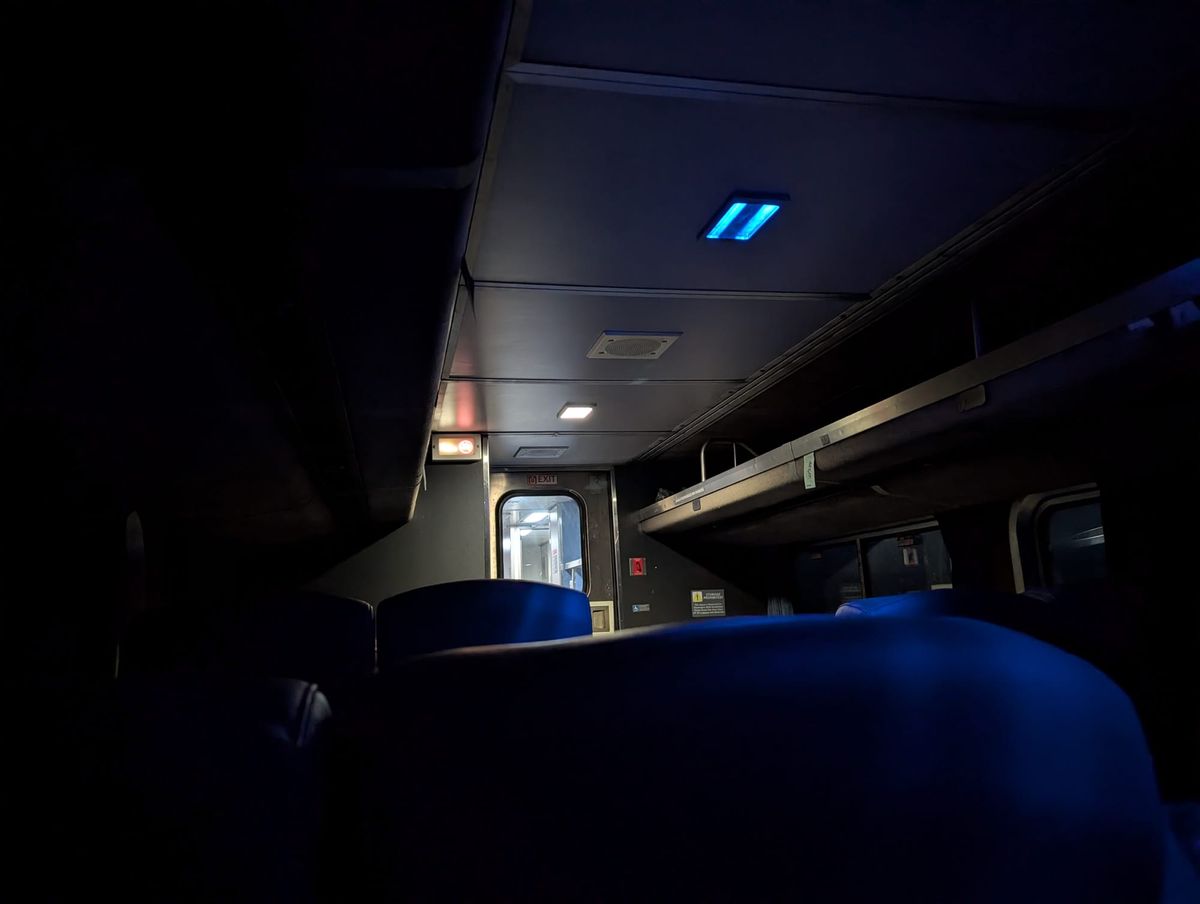
L-R, an example of someone else's seat cushion (that I wish I had thought of), how bright things are at night, and the seats in the lower level.
Sleeping On The Train
We rode in Coach for both directions, and one of my biggest concerns was being able to sleep. I can't sleep in cars or planes, so it was an open question if I would be able to sleep on a train. (It seemed like a waste of money to pay for a Sleeper car, over $1000 more, if I couldn't eat any of the food!)
You're sleeping in a chair in Coach. Yes, it's much nicer than an airline chair, but let's be real: it's still a chair. It does recline a decent amount, and there is a footrest, so it's not hopeless. If you don't have anyone next to you and your body bends that way, you can use both seats - I saw a lot of people curling up. But it's best to plan for the least ideal scenario: sitting upright in your chair.
Building Your Sleep Kit
Just like camping, you're going to need to bring some items to make your sleep as comfortable as possible. We saw people do a lot of different things, and what you'll need will change based on your sleeping ability. If you struggle to sleep in weird places or moving vehicles, take some time to pick and test your gear ahead of time. If you can sleep anytime, anywhere, then - just like the food - you can probably just wing it!
Here is what I think is essential for any hope of sleep on the train:
- A pillow; I recommend a pillow that provides neck support. I used and liked the Coop inflatable one because it gave some support for tilting your neck to the side. We also brought one of these compressible pillows that we previously used camping, since we weren't sure about the sleep setup; it ended up being handy to use to lean against the wall, and later to sit on.
- Noise-cancelling headphones (or, at the very least, earplugs). I would rather skip a pillow than skip having noise cancellation; that is how essential they are. People are getting on and off the train all night, people snore and cough, the door bangs open and closed - it gets loud. Honestly, I also used them during the day when someone in our car insisted on listening to a literal radio, or people had conversations on speakerphone. That said, if you're traveling alone, it could feel uncomfortable using them, so you'll have to gauge your own comfort level.
- An eye mask. The lights are never really completely off on the train, so something that blocks the light is a good idea. I liked the Ostrichpillow mask, and have continued to use it at home! The fabric is really soft, and there's good space for your eyes to open and close with the mask on.
- A blanket. I didn't really need it for warmth, since it was summer, but I was glad I had it to sit on for extra padding. We used our compression camping blankets.
One thing I didn't think of, but wished I'd brought, was an extra cushion for sitting on. I think I may have bruised my tailbone while sleeping. 😅 I saw another passenger with an inflatable seat cushion, and I'd definitely find something like that for the next trip if it is multiple days.