Pocket Notebook Ideas and Layouts
I see so many questions about pocket notebooks! In this entry, I cover some ideas of how to pick out your pocket notebook, how I use mine (with photos of sample layouts), and share some YouTube videos with ideas of different styles to try.

I see a lot of questions about how to use a pocket notebook in notebook and journaling communities online. The quickest answer on how to use a pocket notebook: there isn't a right way, and getting too hung up on the details will stop you from just using it! But having some examples to work with can help, so I thought I'd share how to pick out your notebook and a few ideas of how to use it.
Picking your notebook.
There are a few things to think about when picking out your notebook: size, paper type, accessories (like pockets, a strap to keep it closed, pen loops, etc.), budget, and the general feel of the paper. Since I love stationery, I have lots I could say about all of these things, but here's some info to get you started.
There are a variety of sizes:
- If you like the pocket size (roughly 3.5" by 5.5"), Field Notes, Moleskine, Leuchtturm, etc. are all good picks. (Leuchtturm calls their pocket size A6, but it is 3.5" x 5.9"). YAMAMOTO PAPER makes pocket-sized notebooks, but it has slightly different dimensions. Or, make your own!
- If you are interested in a small notebook but willing to look a little larger, an A6 (4.1" x 5.8") size may be a good fit for you - Midori, Stalogy, and many other brands are great.
- If you want something even smaller than a pocket notebook, look for an A7 (2.9" x 4.1") notebook. LIFE is a common Japanese brand for A7 notebooks.
- B6 (5.0" x 7.2" in Japan) and B6 Slim (6.9" x 4.2") are fun sizes to experiment with! Slim versions are not quite as wide as a typical B6, so they would fit in your pocket a bit easier than a standard B6.
- If you want to make a whole "system" out of it, you could look at Traveler's Style versions with multiple inserts. Their Passport size is 3.5" x 4.9", which is close to a pocket-sized notebook.
- The covers are a bit expensive if you're just experimenting, so I recommend trying other versions out first, but do what you'd like! There are also DIY videos for making your own covers, or you can find cheaper versions online.
For more details on all the different paper sizes, check out JetPen's page about it - it has great info! You can also sort their notebook selection by size to see what you like.
Accessories and features:
- Pockets: Moleskine and Leuchtturm are some of the only notebooks that reliably have pockets. That said, it is easy to use a case/cover or add a pocket!
- Bands/closures: Moleskine and Leuchtturm win here, with included bands to keep the notebook closed. I picked the fabric cover for the Field Notes that had a band. Or, just use a regular rubber band!
- Covers/designs: Field Notes have a wide variety of covers, which can be a lot of fun to collect! Others are mostly solid colors, but you can add stickers and other designs if you'd like. Midori has white-only covers, which could either be boring or a blank slate, depending on your mindset.
- Binding: This is niche, but may be important to you! Field Notes are bound using staples, which I've found makes them a bit more delicate. Most Japanese brands have lay-flat binding, so the notebook (obviously) lays flat when open - which can be really nice with small notebooks!
Consider what pens you use:
- Many of the brands that make pocket-sized notebooks typically use a bit thinner paper and/or have bleed-through, so you'll need to test any pens you want to use with them. Field Notes, Moleskine, and Leuchtturm are notorious for being bad with fountain pens, but work well with other types of pens.
- Many Japanese brands (Midori, Stalogy, etc.) will use paper that is fountain pen friendly, if that is important to you.
What notebook do I use?
Previously, I was using two Field Notes notebooks in a water-resistant fabric case (more info and pictures in this post). One of the notebooks was more of a zibaldoni-style spot for collecting quotes, poems, lists of things, etc. - things I wanted to record and remember, but not necessarily something that needed follow-up. The other notebook was for to-do lists, brainstorming, and that sort of thing - things I was going to take action on.
After a while, it became irritating to have to decide which notebook things went into. Is this a quote I wanted to use in a project, or is it a quote for the zibaldoni? Is this list I want to reference as a to-do, or is it a list for memory keeping? This started creating a lot of friction when using the notebooks, and I found myself using them less and less.
So, in August, I bought a pocket-sized Moleskine notebook, and it is my catch-all for everything. (This is the notebook I am sharing example layouts from below.) It is essentially the two prior notebooks combined! I use a Uni-ball Zento .38 with it, and it works well with the Moleskine paper.
But you can use any notebook you want - I just picked the Moleskine because it was easy to find, and though I've historically been very grumpy about their paper, it has been working fine for me right now. I like having one spot where I can dump everything!
How do I use my notebook?
The best way I can describe my style is a modified Bullet Journal zibaldone. I like to include quotes and poems I've found, but I also have running to-do lists. I like having an index, and I experiment with using the monthly overview, but I skip the collections, weekly log, future log, etc. that is part of the Bullet Journal method, and I don't really do a running list during the day the way it is described in Bullet Journaling. (If you're not familiar with the Bullet Journaling system, I've included a video below with more info.)
Here's how I like to use my pocket notebook:
- The first page of a notebook always feels a bit weird to me, so I like to start the notebook with some of my favorite quotes of the moment. I've also clipped in a photo I took recently that I really like!
- I start the index on the last page of the notebook and work my way backwards. Trying to guess how many pages in the beginning to reserve for the index always stresses me out, and I don't want it to be the first thing I see every time I open the notebook. So, I start my index on the last page, and work backwards as needed. Eventually, the notebook content will meet up with the index.
- I do have a monthly log, but I don't usually put much detail on it. It is more of a way to indicate where I am chronologically, but I have a Google Calendar and a planner that I use for actual schedule keeping. I do like to keep some events on it that have an associated to-do to help me remember - such as birthdays, so I remember to buy a card ahead of time.
- I use the notebook vertically when doing my to-do lists. This is an idea from Ryder Carroll, the creator of Bullet Journal (he talks about it here), and I like it a lot! It gives a lot more room to write, and also makes it really easy to see when flipping through which pages are to-do lists and which are something else.
- I use the symbols from the Bullet Journal method (mostly).
- I use the to-do list as more of a check-in when I have my "what am I even doing right now" moments. I include the top things I want to accomplish that day, not an exhaustive list of everything I need to do. (It's sort of counterintuitive and would take too long to explain why it isn't my whole to-do list, but the system works well for me right now.) I like to keep this notebook open on my desk while I am working as a reminder.
- I use paperclips to clip together irrelevant pages, so I can flip easily between important things. Sometimes there are multiple pages that I am no longer referring to between two important pages, so I will use paper clips to gather together the unimportant pages. That way I can flip back and forth quickly! (You can see one of them on the monthly overview below, though I usually have 2-3 in use at a time.)
Here are a few pictures of example layouts:
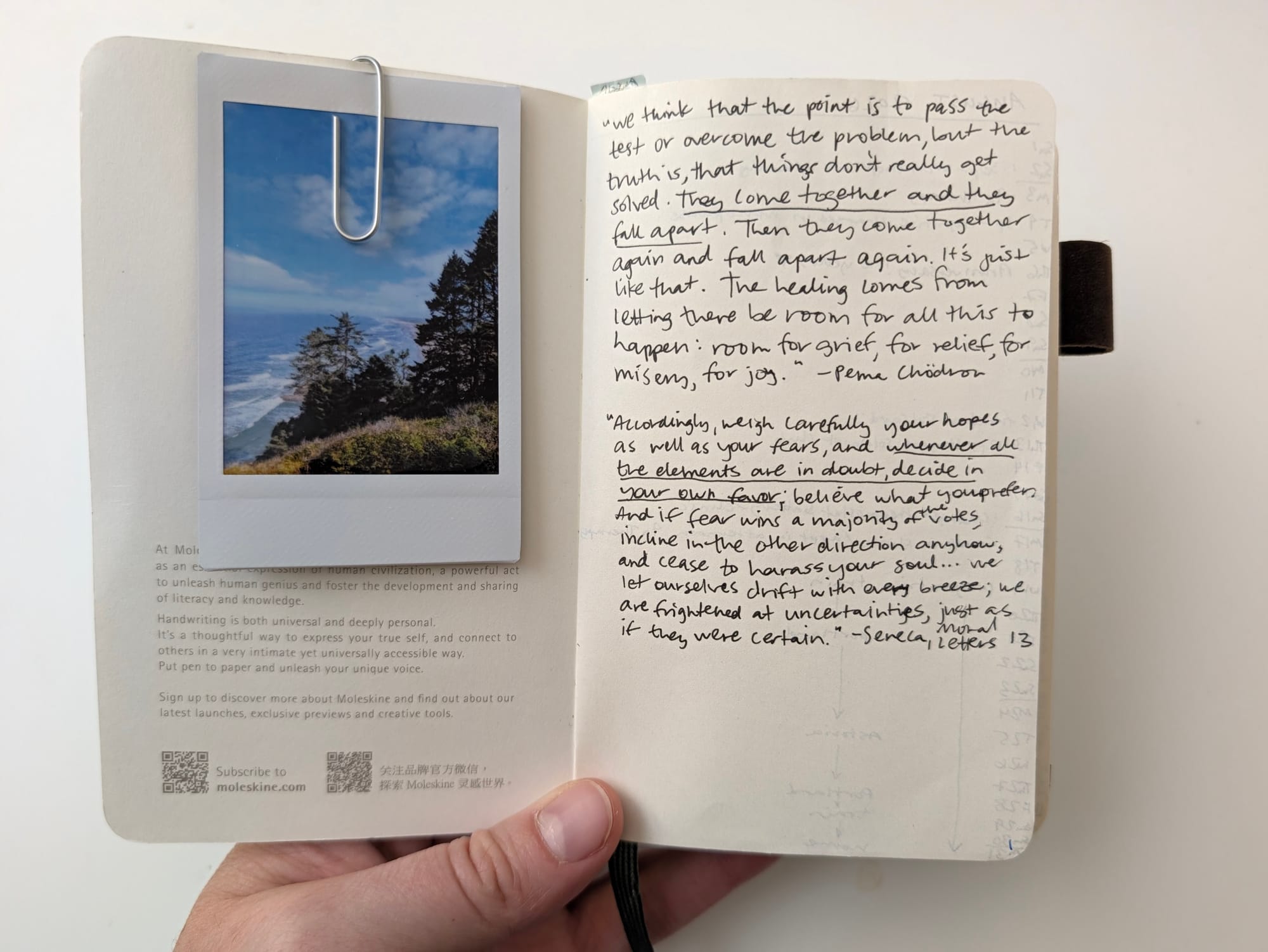
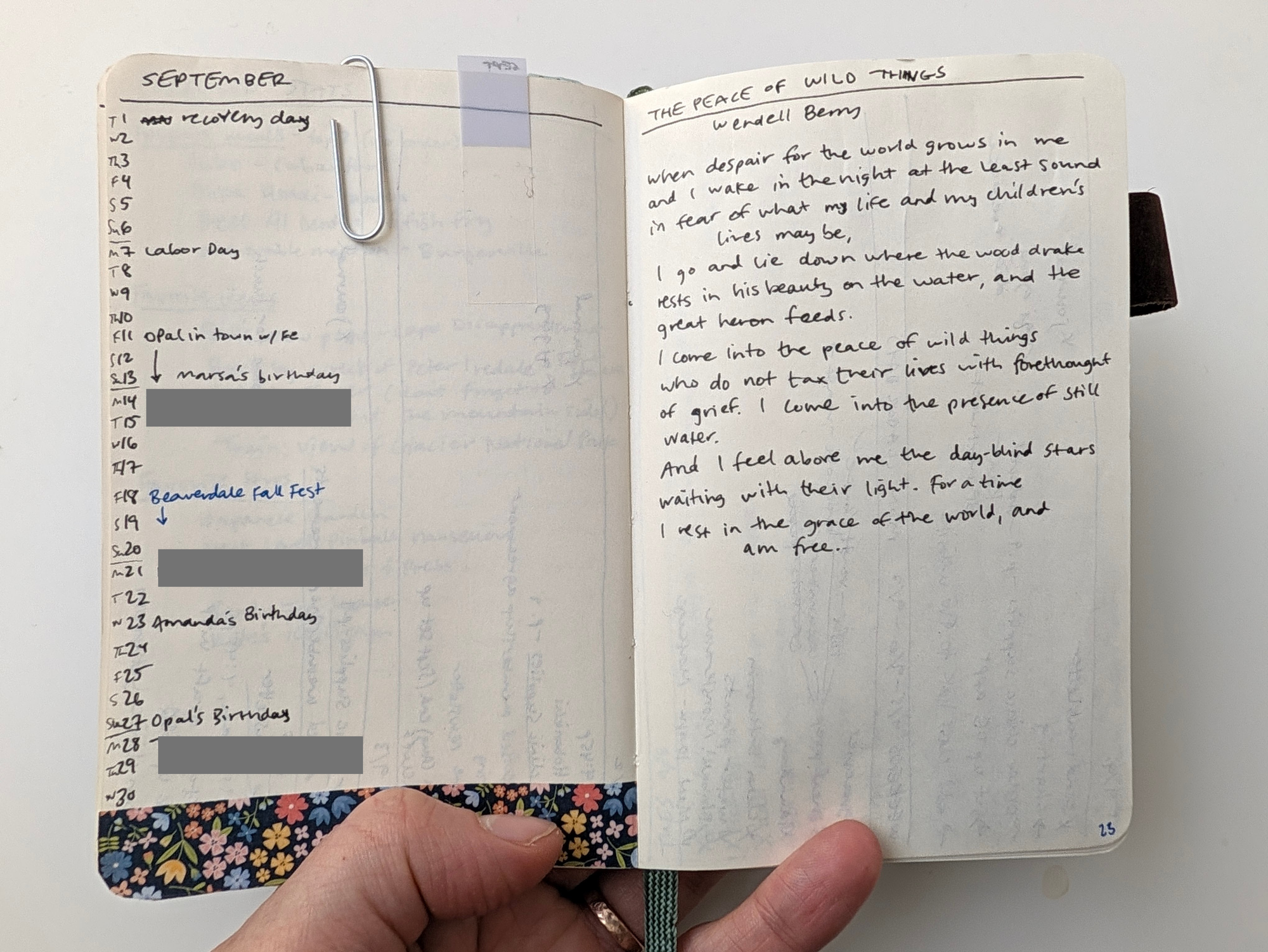
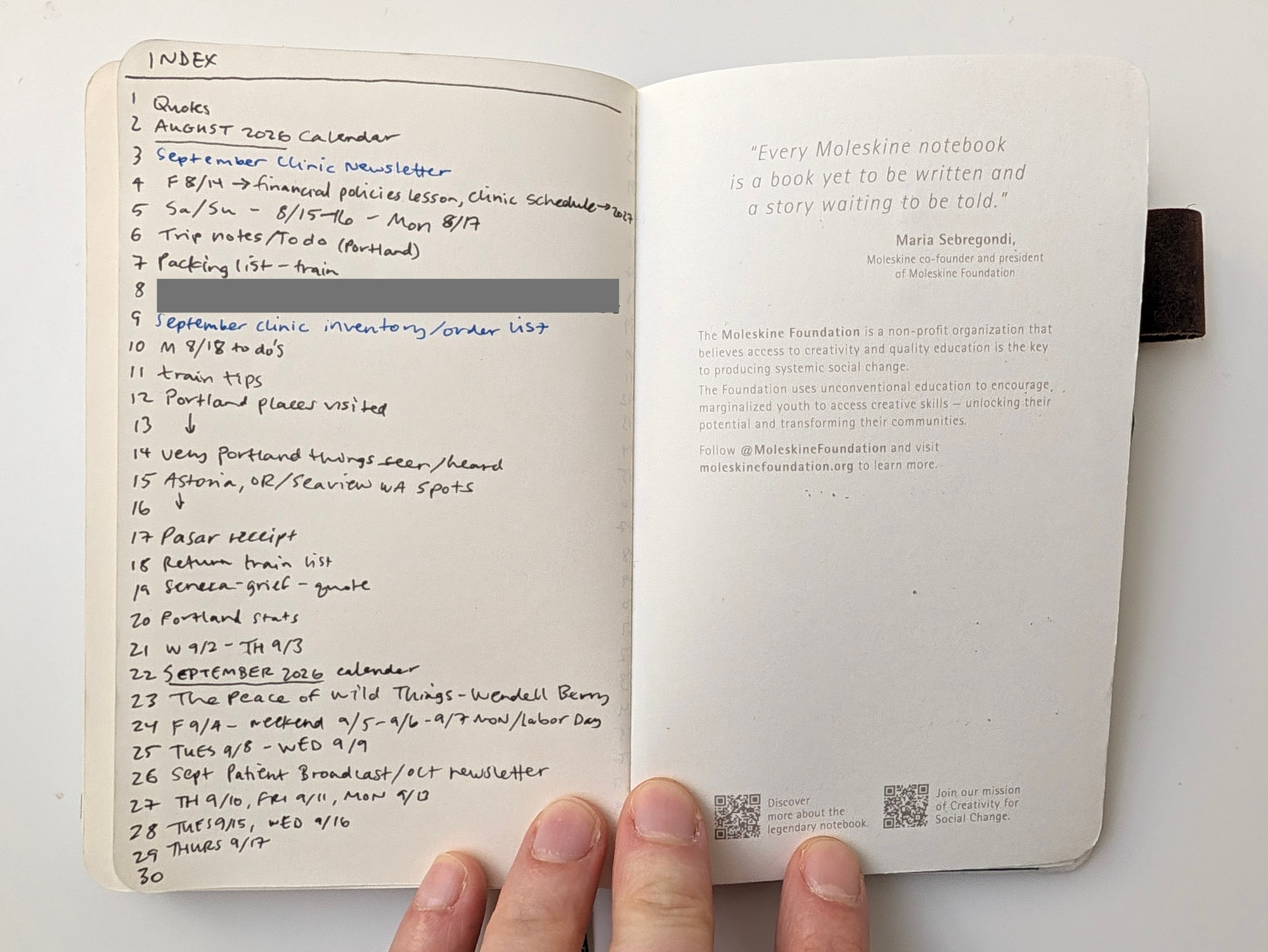
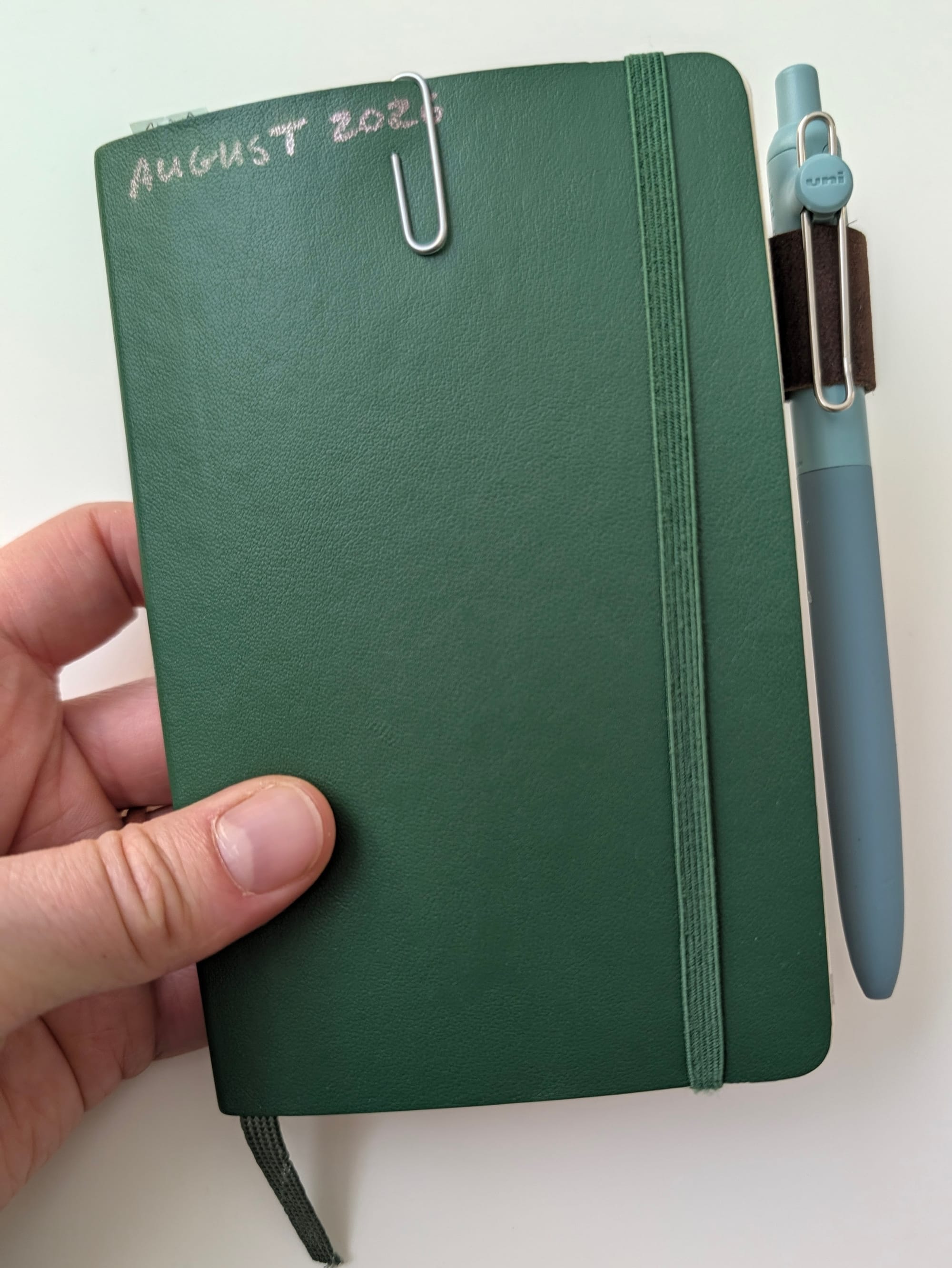
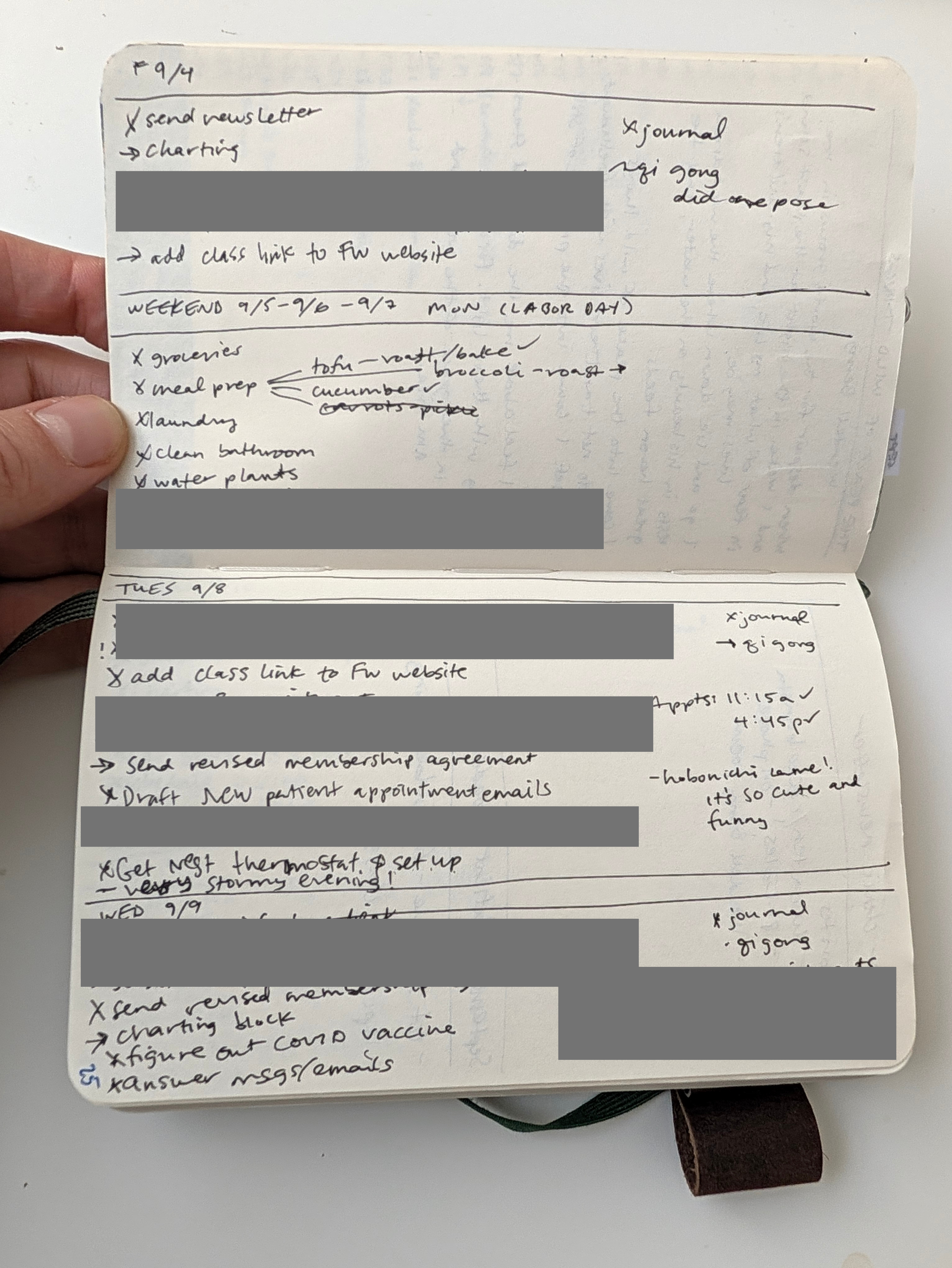
Photos clockwise starting top left: The first page with quotes and a photo; monthly log with a poem; index starting on the last page and working backwards; the cover with the date the notebook was started; and an example of the running to-do list using a vertical view.
Some videos to get you started:
There are hours and hours of content on YouTube on how to set up and use a pocket-sized notebook. Here are a few of my favorites, which offer something a bit unique or were especially helpful for me!
I really liked seeing the evolution in how he used his notebooks! His journal/to do list style is probably the closest to how I do my notebooks too.
Here's the official way to Bullet Journal; as I mentioned above, I use a version of it. Make the system your own!
More productivity-focused uses for a pocket notebook.
This is a deep dive in using pocket notebooks in more contemplative, philosophical ways - and how it can help you avoid the infinite scroll.